This blog post is designed to help Hong Kong employers navigate the unique social and legal landscape of the Philippines.
The "Single" Parent Paradox: Understanding Family in the Philippines
A Guide for Hong Kong Employers and Families
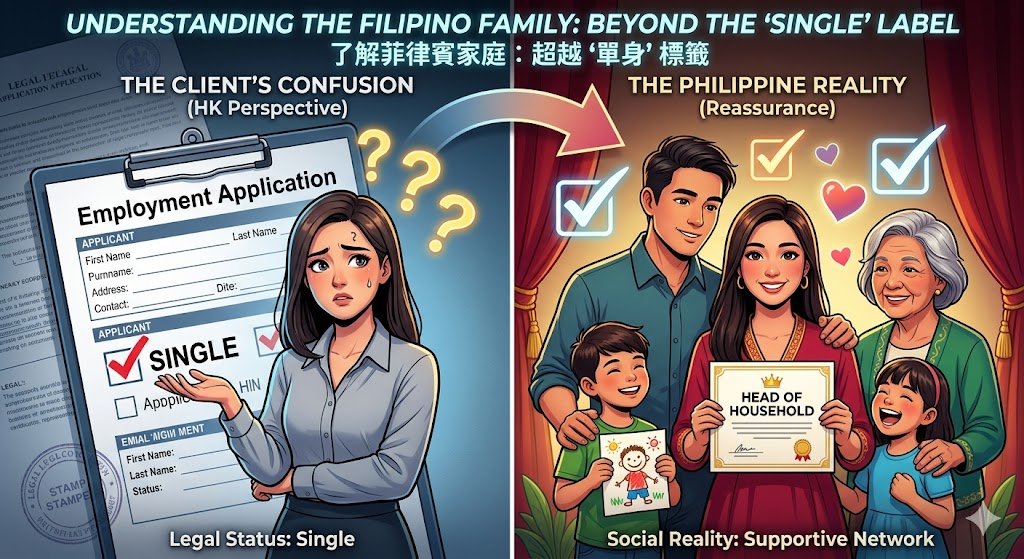
In Hong Kong, we value clarity. When we see "Single" on an application, we imagine someone with no ties. When we see "Married," we imagine a stable household. However, applying these same definitions to a Filipino candidate can lead to a significant misunderstanding of who they really are.
In the Philippines, "Single" is often a legal technicality, not a social reality. Because the Philippines does not have a divorce law, many people who have been in committed, 10-year "partnerships" with children must still write "Single" on their ID cards.
To help our Hong Kong clients find the most reliable and stable candidates, Arrow is moving beyond these confusing legal labels. We are introducing four new status categories that describe the actual responsibility a person carries at home.
The 4 New Family Status Categories
To provide more transparency for our customers, we now categorize our candidates based on their household dynamics rather than just their legal paperwork:
1. Married (Legal)
Who they are: These candidates have a formal marriage certificate recognized by the government.
What it means for you: This represents a traditional family structure. In many cases, the spouse remains in the Philippines to manage the household or works alongside the candidate to support the family.
2. Domestic Partnership
Who they are: These candidates live in a stable, long-term relationship with a partner (and often children) but are not legally married.
What it means for you: This is the most common "unseen" status. These candidates have the stability of a two-parent home. They have a partner at home to help with childcare and emergencies, making them highly reliable employees who aren't "alone" in their responsibilities.
3. Head of Household (Solo)
Who they are: This candidate is the primary leader and financial engine of their family. They may be widowed, separated, or a solo parent managing their children and often their elderly parents.
What it means for you: These are often the most motivated workers. Because an entire multi-generational family depends on their salary, they have an incredibly high "grit" and commitment to their job. They are the "CEOs" of their homes.
4. Single (Unattached)
Who they are: Candidates with no children, no live-in partner, and no previous legal ties.
What it means for you: These candidates typically offer the highest flexibility. They have fewer domestic distractions and can often adapt quickly to new schedules or travel requirements.
Why This Matters for Your Family
In Chinese culture, we often worry that a "Single Parent" might be distracted or lack support. But in the Philippines, the "Extended Family" is the safety net. Whether a candidate is in a Domestic Partnership or is a Head of Household, they are rarely "alone." They are supported by a network of aunts, grandparents, and siblings.
By using these new labels, we help you see past the "Single" checkbox and understand the true strength, stability, and motivation of the person you are bringing into your home.
Note to Employers: When you see "Domestic Partnership" on an Arrow profile, remember: This person has the commitment of a marriage, even if the law hasn't given them the piece of paper yet.
