
When Anger Is Costing You Money
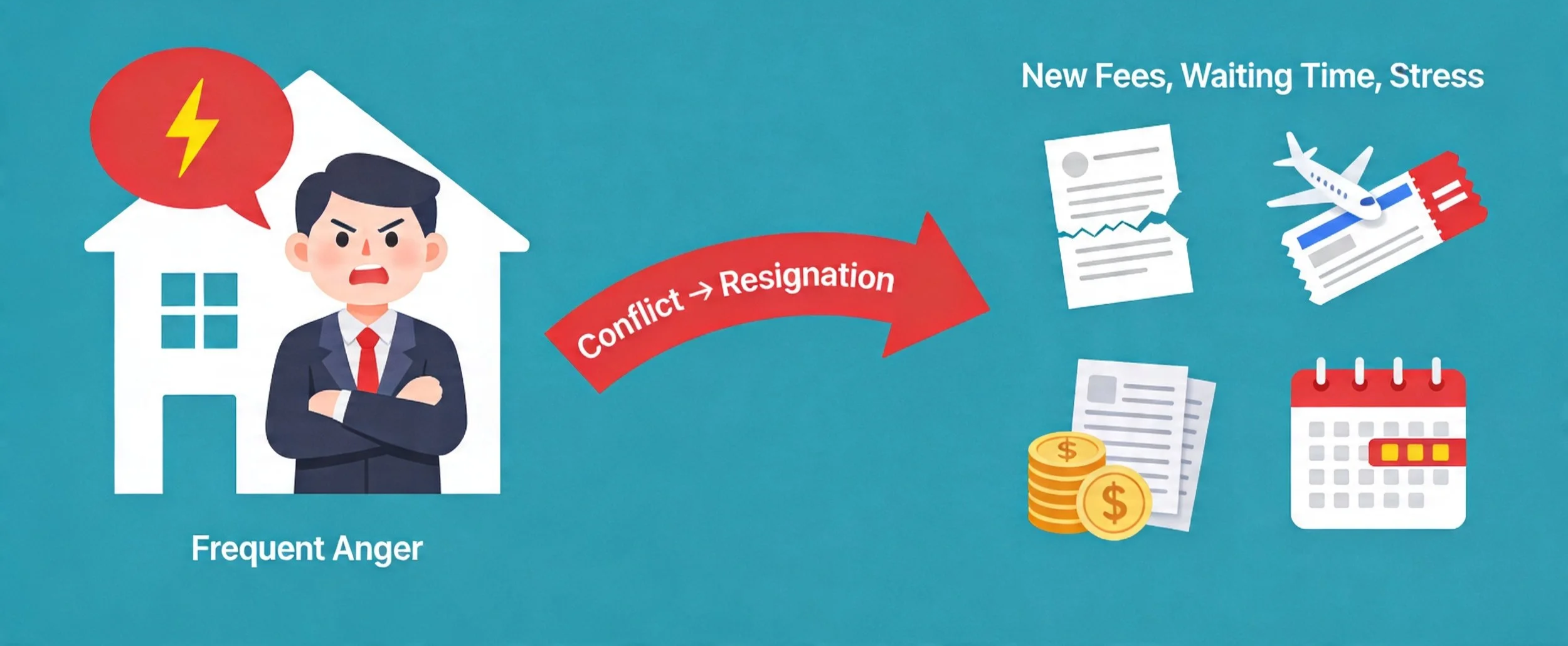
1. The Hidden Price Tag On Your Temper
Many Hong Kong employers think of anger as a purely emotional problem: “I know I get angry, but that’s just my personality.”
What most people don’t realise is that frequent anger is also very expensive.
At Arrow, we regularly meet helpers who refuse to renew with an employer for one simple reason:
“My madam is always angry.”
When that happens, the employer doesn’t just “lose a helper.” They lose:
Agency fees for the next hire
Government fees and documentation costs
Two–three months of waiting for a new helper to arrive
Weeks of re‑training, mistakes, and adjustment
If you add this up across several contracts, an angry pattern can cost tens of thousands of dollars over a few years—plus a lot of stress for your family.
2. How Anger Destroys Contracts (Step By Step)
In more than 15 years of Arrow’s work with employers and helpers, we’ve seen the same pattern again and again.
Small mistakes happen
The helper is new, tired, or unsure. She forgets something or doesn’t do it “your way.”
Employer responds with sharp anger
Voice is raised, harsh words are used, mistakes are repeated again and again in the scolding.
Sometimes the anger has been building from other areas of life (“old anger”) and lands fully on the helper.
Helper becomes anxious and defensive
She starts to fear every mistake, so she hides problems or blames others.
She doesn’t feel safe to be honest with you.
Communication breaks down
Employer stops giving calm instructions, only speaks up when very upset.
Helper stops asking questions, because questions often lead to more scolding.
Resignation or termination happens
One day you hear the words: “Ma’am Sir, I want to resign.”
From our experience at Arrow: once a helper clearly says she wants to resign, she almost never changes her mind.
The expensive cycle repeats
Another hiring process, another adjustment period, another chance for the same anger pattern to play out.
The key point: anger doesn’t just hurt feelings; it directly pushes helpers towards resigning or not renewing, and each lost contract costs real money.
3. Rough Cost Of An Angry Resignation
Every case is different, but here is a rough picture of what one broken contract can cost a Hong Kong employer:
Agency fees + processing for a new helper
Hong Kong government fees and required documentation
Air ticket and related costs if you terminate or she finishes and leaves
At least 2 months with no full‑time helper at home while you wait for the new one
Time off work for interviews, immigration visits, medical checks
Extra spending on part‑time help or babysitting during the gap
And that’s just the money.
You also pay in:
Stress for you and your spouse
Instability for children, who may already be attached to the helper
Emotional strain on the helper’s side, which often feeds into her next job
If anger leads to two or three broken contracts over a few years, the total cost is significant.
Learning to manage your anger is not only about being “nice”; it’s a smart financial decision.

She may look calm on the outside, but on the inside helpers are often terrified. Terrified workers do not stay long.
4. “But Isn’t The Problem My Helper?”
You might be thinking:
“I’m angry because my helper is careless. If she just did her job properly, I wouldn’t lose my temper.”
We hear this a lot. But in many cases, when we listen to both sides, we discover that anger is not coming from today’s mistake only. It is often “old anger”—built up over years from stress, work, marriage, family, and past hurts.
Your helper may trigger your anger, but she is rarely the true source of it.
Also, many employers do not manage their helper like they would manage staff in a professional office:
No clear job description
Little or no training or handover
No regular performance reviews or encouragement
Mostly negative feedback, given when emotions are boiling over
If you treated your office staff like that, you would expect high turnover. It’s the same at home.
This is good news: if you change the way you manage and respond, you can dramatically improve the chances of keeping a good helper long‑term.
5. Signs Your Anger Might Be Costing You
Consider these questions:
Do you often raise your voice at your helper?
After a conflict, do you feel regret or think “I went too far”?
Has your helper ever said she is “scared” of you, or become very quiet and withdrawn?
Have you gone through several helpers in the last few years, with similar complaints each time?
If you answer “yes” to several of these, your anger is probably not just a “private issue.”
It is costing you money, peace, and stability.
6. Practical First Steps To Reduce The Cost Of Anger
You don’t need to become a “perfectly calm” person overnight. Start with small, realistic steps.
6.1 Pause Before You React
When you feel your anger rising:
Pause for 10–30 seconds.
Lower your voice on purpose.
If needed, say: “I am upset now. I will talk about this in a few minutes.”
This short pause can prevent the kind of explosion that leads helpers to think, “I need to leave this house.”
6.2 Correct Like A Professional Manager
Try to handle the situation more like a workplace:
Focus on one or two specific issues, not a long list of everything she ever did wrong.
Speak about behaviour, not identity.
“Please wash the dishes immediately after cooking,” instead of “You are so lazy.”
Explain what you want next time, not just what went wrong this time
6.3 Schedule Calm Conversations, Not Angry Ones
If there are ongoing issues:
Choose a calm time, not the middle of a busy morning.
Sit at the table, talk for 10–20 minutes about work, rest, and communication.
Avoid turning it into a “venting session.” Your goal is to solve problems and keep the contract, not to release all your frustration.
6.4 Use Your Agency Early—Not When It’s Too Late
From Arrow’s experience, by the time a helper clearly says, “I want to resign,” it is usually too late to repair the relationship.
Instead of waiting until the breaking point:
Call us earlier if you notice rising conflict, silence, or serious misunderstandings.
Let our customer care team listen to both sides and suggest practical steps.
Sometimes one or two guided conversations can save a contract and all the costs of starting again.
6.5 Consider Deeper Anger Help
If you notice that you are often angry—not just with your helper, but also with your spouse, children, or colleagues—this may be a sign of deeper, “old” anger that needs attention.
In Hong Kong there are:
Counselors and therapists
Anger management courses and workshops
Investing in this kind of help is not a sign of weakness; it is an investment in your family, finances, and future helpers.
7. The Real Question: What Do You Want Long‑Term?
Most employers tell us they want the same things:
A stable helper who stays several contracts
A peaceful home where children feel safe
A relationship built on trust and respect, not fear
If that is your goal, it is worth asking:
“Is my way of handling anger moving me towards this, or away from it?”
You cannot control everything your helper does.
But you can control how you respond—and your response is often the difference between a renewed contract and another expensive resignation.
Learning to manage anger is not just about being a “nice employer.”
It is about protecting your family’s finances, stability, and peace for many years to come.
Summary
Frequent anger doesn’t just hurt feelings; it pushes helpers to resign or not renew, which costs you money and stability.
Each broken contract means agency fees, government charges, months without a helper, and emotional stress for your whole family.
Often the problem is unmanaged, “old” anger and unprofessional management, not just the helper’s behaviour.
Simple changes—pausing before reacting, correcting professionally, using Arrow’s support early, and seeking deeper help if needed—can save both money and relationships.
